Cosmetic Veneers

Comment

Cosmetic Veneers

Today’s technological advances have afforded a great deal of flexibility in modern dentistry. We can now treat a wider range of concerns with more precision and less invasive techniques. Ultimately, this has lead to more “conservative” treatment options- solving the same problems with less collateral interference. One of the best examples of this new approach and ideology is the rise and popularity of dental veneers.

Although veneers have been around for many years, new technology has made them an excellent long-term treatment option for esthetic concerns. In it’s most basic form, a veneer is a thin piece of material that is used to replace the lip side of anterior (“smiling”) teeth. This material is made by a dental lab and used to correct the shape, color, length or spacing of the teeth.
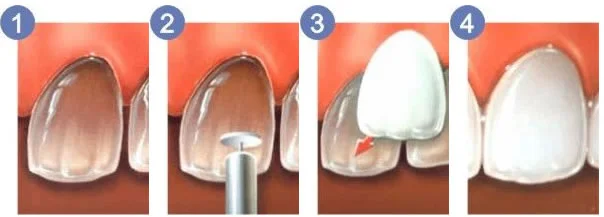
1) an existing tooth has become discolored or misshapen. 2) a minimal amount of tooth structure is removed to accommodate the new veneer 3) The new veneer is tried on to ensure esthetics 4) the final product is adjusted and cemented

1) an existing tooth has become discolored or misshapen. 2) a minimal amount of tooth structure is removed to accommodate the new veneer 3) The new veneer is tried on to ensure esthetics 4) the final product is adjusted and cemented

In the spectrum of cosmetic dentistry, veneers occupy the space between cosmetic bonding and full coverage crowns. Large deficits in size and shape cannot be reliably addressed with bonding composites. Since a veneer is a single piece of solid material, it offers more overall rigidity. Additionally, a veneer can be made to match adjacent teeth in ways bonding never can. Color gradients, shapes and artifacts can all be added to the veneer to make it blend in perfectly with the rest of your smile. Conversely, since veneers only address cosmetic concerns, they are less invasive than a full coverage crown. Less natural structure has to be removed as the underlying tooth is still structurally sound.

A number of recent technological developments have perfected veneer preparation and placement. We now make veneers out of an engineered lithium disilicate called Emax. Emax is a translucent, tooth colored material that combines unmatched esthetics and incredible strength. It is perfect for anterior teeth as it is both functional and beautiful. The labs we work with will schedule a shade-matching appointment to make sure your Emax unit is flawlessly matched to your surrounding teeth. They will help guarantee that the color, gradient, shape, length and width are in perfect harmony with the rest of your mouth.

In addition to developments in the veneer material, the bonding agents we use have made the process easier and more predictable than ever. Since Emax is extremely translucent, the color of the underlying “glue” can severely alter the appearance of the final product. With this in mind, we use a combination of clear cement and mock try-in material known as Cosmedent Insure/Prevue. The Prevue material has the same viscosity and value as the Insure cement, and allows us to confirm esthetics without actually cementing the veneer. Once we are satisfied with the esthetics of the restoration, Insure is used to create a strong, lasting bond.

If you have one, two or more defects or deficiencies in your anterior teeth, veneers could be an excellent option to restore your beautiful smile. At our office, we place veneers to fix everything from single teeth to entire anterior arches. However, we evaluate each case for its appropriateness to be solved with veneers. Often times a combination of cosmetic bonding, orthodontics and smoothing/disking can offer similar results, albeit with a different time frame. If you are considering veneers, we urge you to schedule a consultation with Dr. Kari to best evaluate your personal needs, desires and expectations from our treatment!


Comment

BruxZir Crowns

Comment

BruxZir Crowns

http://www.thousandoaksfamilydentistry.com/blog/2014/6/19/bruxzir-crowns

At our office, we want all of our dental work to be beautiful, functional and enduring. Many times, finding the intersection point of these three qualities requires us to turn to new technologies and developments in dental materials. In the case of dental crowns, we utilize BruxZir milled zirconia as a beautiful restorative solution that stands up to even the toughest conditions.

In the human mouth, the farther back a tooth is, the more relative force it will receive during a regular day. Teeth closest to the jaw joint are situated right next to the masseter, the muscle responsible for chewing, biting and closing the mouth. This muscle can generate incredible amounts of force, enough to crack or fracture your own teeth. Because of this, many types of crowns will chip, break or fail in the rear of the mouth.

A diagram highlighting the masseter muscle. 

A diagram highlighting the masseter muscle. 

In the past, porcelain fused to metal (PFM) crowns were the best tooth colored solution for posterior teeth, as their solid metal underpinnings are incredibly durable. However, the baked on porcelain can fracture and break during normal wear, requiring replacement or adjustment. Gold crowns were popular as well, so long as the patient was comfortable without a tooth colored restoration. Other materials, such as full porcelain crowns, are simply too fragile to be placed in such a functional position.

In contrast, Bruxzir crowns combine longevity, strength and natural beauty. They are milled out of a solid piece of engineered zirconia to match the color and shape of the original tooth. Since it is a single piece of material, it better matches the light characteristics of natural teeth. There is no metal backbone block out and less tooth structure has to be removed to accommodate the newly made crown.

While some materials (such as Emax) offer better translucency and color properties, nothing can stand up to BruxZir’s durability. They are essential chip, grind and crack proof. Even with heavy grinders and clenchers, the single piece zirconia will not fail or erode. No other material can offer this level of endurance in an esthetic, tooth colored package.

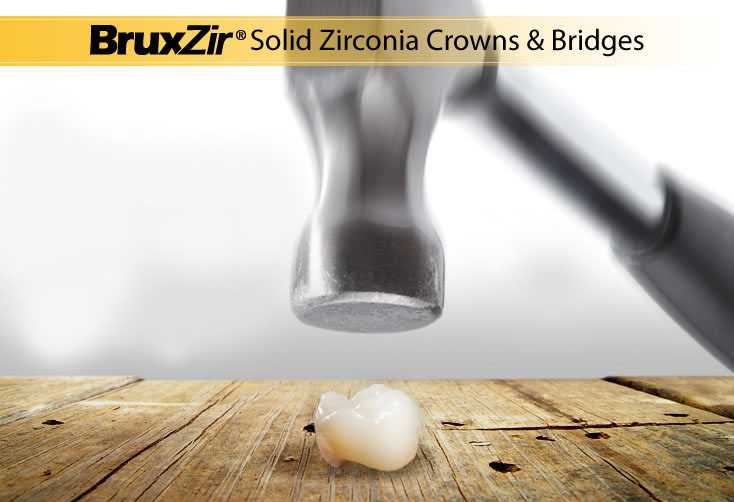
Even taking a hammer to a BruxZir crown will not ruin it's structural integrity. 

Even taking a hammer to a BruxZir crown will not ruin it's structural integrity. 

We typically only place BruxZir crowns on molars and more rearward teeth. While these units are esthetically superior to PFMs, they are not as cosmetically versatile as Emax crowns. In essence, their incredible strength comes with the price of poorer relative translucency. For front teeth experiencing less average force and wear, we will typically place this more esthetic material. Of course, we still place PFM and gold crowns, but most patients are eligible and more willing to be fitted with these state-of-the-art units.

If you have any further questions about BruxZir crowns, or any other crown materials at our office, please give us a call. We would love to talk you through your crown options, and which material would work best for you personally!

Comment

Crowns and Bridges

Comment

Crowns and Bridges

Hands down, dental crowns and bridges are the most versatile restorative tools at our office. Whether going on previously decayed teeth, root-canaled teeth or a dental implant, they offer convenience, beauty and excellent flexibility. Please take a moment and read why we love crowns and bridges at Thousand Oaks Family Dentistry!

In it’s simplest form, a dental crown is a hard, solid object that replaces the natural “crown” of the tooth. It can add structural rigidity, biting function or esthetic value to any damaged or decayed teeth. Similarly, bridges are three (or more) crowns made in tandem, were the outermost two units are attached to your natural teeth (or implants). The goal is to “bridge” the gap created by a tooth that was previously removed. Both crowns and bridges are prepared using the same techniques.

Crowns and Bridges are placed for a number of reasons. Crowns can be used to fix teeth that have too much decay to be rebuilt with a dental filling. They can also restore structure after a tooth becomes cracked (depending on the nature of the crack). Bridges are used to replace once-missing teeth in almost any area of the mouth. All that is required is that the gap is “surrounded” by viable teeth for the bridge to be mounted to. Likewise, implant crowns are the final restorative step in implant surgery and give the implant its beauty and functional ability.

The basics of how a tooth is prepared for a crown. (Read top left to lower right)

The basics of how a tooth is prepared for a crown. (Read top left to lower right)

To prepare a tooth for a crown or bridge, we essentially remove a ~1.5mm gap from around all surfaces of the tooth, in addition to any defects or decay. The walls of the teeth are slightly tapered, so that the crown can be placed easily and has ample tooth structure to hold on to. At the gumline, a distinct ridge (called the “margin”) is created to give an explicit surface for the crown to be cemented against. In the case of bridges, this step is done on two separate teeth, with special care given to making both teeth completely parallel. For implant crowns, these steps and designs are built into the shape of the abutment, which is essentially a manufactured “undertooth” made at an off site dental lab.

1) A natural tooth is broken/decayed and cannot be repaired with a filling 2) The tooth is prepared for a crown, giving it clearance for the new unit and proper structure. 3) The final crown is cemented and delivered. 

1) A natural tooth is broken/decayed and cannot be repaired with a filling 2) The tooth is prepared for a crown, giving it clearance for the new unit and proper structure. 3) The final crown is cemented and delivered. 

Preparing and delivering bridges is done with much the same technique. However, a missing tooth is replaced in the process. 

Preparing and delivering bridges is done with much the same technique. However, a missing tooth is replaced in the process. 

After your tooth is prepared, we have a number of material options for making your crown or bridge. In nearly every case, we will use tooth colored materials and restorations. We can match almost any esthetic concerns, from color to matching staining patterns and the shape of adjacent teeth. For front teeth, we often use eMAX lithium disilicate crowns for their excellent esthetic properties and strength. In molars and back teeth, we typically place a material called Bruxzir. Bruxzir is an engineered zirconia that surpasses all other crown materials in terms of hardness and durability. We also have a number of more traditional crown materials at our disposal, ranging from gold to zirconia and porcelain fused to metal (PFM). Picking a crown material is a discussion between you and Dr. Kari that considers your whole-mouth condition and your specific wants and needs.

An example of an eMAX bridge/crown. 

An example of an eMAX bridge/crown. 

At a crown preparation appointment, we start by getting you numb and taking an initial impression for our temporary crown. We then prepare the teeth, taking care to provide ample clearance for the new unit. Once the tooth is fully prepared, we take a final impression and make notes for the lab. Finally, we use our first impression to make an acrylic temporary. While this will not be as strong as your final crown, it will allow you to leave with a fully shaped tooth. This is important for esthetics, chewing function and for maintaining the space between the prepared tooth and the opposing tooth. After two weeks, the lab will deliver your crown, which will be adjusted, seated and cemented in a quick follow up appointment. The process for implant crowns is slightly different, but still requires appointments for initial impressions followed by the actual crown delivery.

If you have any further questions concerning dental crowns, please give our office a call. We place and deliver crowns almost every day and can walk you through your unique needs. There should be no confusion, fear or apprehension surrounding your crown or bridge treatment!


Comment

Dental Sealants

Comment

Dental Sealants

    One of the most common preventative dental treatments available to growing kids and teens is dental sealants. Between 10% and 50% of all students will have at least one sealant at any given grade school in the United States. While many parents are well educated on the benefits of sealants, the whole picture is slightly less clear. What are they made out of? What exactly are they “sealing?” Are they designed to last forever? In this blog post, we will shed some light on commonly asked questions on dental sealants and how they can be excellent preventative tools in young teeth.

Deep enamel pockets in the biting surfaces of molars can create difficult-to-clean teeth. 

Deep enamel pockets in the biting surfaces of molars can create difficult-to-clean teeth. 

    The principle behind dental sealants (also known as pit and fissure sealants) is very simple. In young children and teens, tooth anatomy can be deep and varied. In the molars, these “pits” (natural dips in the teeth) and “fissures” (natural troughs in the teeth) are prone to collect bacteria and acidic food particles. Unfortunately, these groves are often too big for toothbrush bristles to invade and clean. The result is a perfect pocket of food and bacteria that can sit unharmed even after a perfect brushing session.

    Sealants come into play by making these ridges and pockets shallower by using a specialized filling material. We typically place sealants on adult teeth once they are fully erupted and show signs of deep tooth anatomy. Baby teeth are usually shallow enough that sealing them is an unnecessary measure. The necessity and appropriateness of sealants are typically determined at a regular cleaning/exam appointment.

    In placing a sealant, we first use air abrasion technology to gently roughen the tooth surface around the pits and fissures. This process is extremely gentle; your normal saliva flow has strong enough remineralization powers to reverse the effects of air abrasion. After the tooth is prepared, we place a hard material called glass ionomer into the pits and grooves. We love glass ionomer because it is engineered to provide prolonged fluoride release, making it perfect for this application. Once the material is hardened and set, we perform a final adjustment to make sure the sealant isn’t interfering with normal biting and chewing. The entire appointment takes about 30 minutes for one tooth, with 15 extra minutes for each additional tooth.

A typical before (left) and after (right) of dental sealants. 

A typical before (left) and after (right) of dental sealants. 

    Since we are only placing material in near-microscopic grooves (thinner than a toothbrush bristle!), the resulting “filling” is incredibly shallow and thin. Likewise, sealants can fall out or break after a number of years. This is a completely natural and expected part of the sealant life cycle. However, many of our patients have their sealants last for near lifetimes. When a sealant does fall out, we note it during a regular exam and consider the options. We can replace a sealant at any age, but changes in tooth structure often make this step unnecessary.

     For most people, extreme molar anatomy is exclusively a childhood problem. Children's teeth grow in at different paces and will often be in a position where they have nothing to hit against while chewing. This lack of constant contact makes these pockets of bacteria and food even harder to displace.  However, we can and will place sealants in adults, if necessary.

    Please note that sealants are not the same as fillings on the biting (“occlusal”) surfaces of your back teeth. If there is active decay in the pits and fissures, we must place a filling to reverse it’s progress. However, deep anatomy can usually be caught and adressed before actual decay sets in. If you have any further questions about dental sealants, how they work or why we place them, please feel free to call our office. We want all of our patients to be well educated on the best preventative services available to them and their children.


Comment

Home Whitening- Frequently Asked Questions

Comment

Home Whitening- Frequently Asked Questions

With so many whitening options, which one is best for me?

With so many whitening options, which one is best for me?

If you spend enough time watching tv or browsing the internet, you are bound to see some sort of advertisement for teeth bleaching. With such a huge demand and emphasis on facial esthetics, many companies and organizations are trying to win your business with the promise of a whiter smile. At Thousand Oaks Family Dentistry, we wanted to take a moment to inform you on the hows and whys of whitening so that you can make the best decision for your personal needs. Take a look at our home whitening frequently asked questions:


1. How does whitening work?

Whitening, whether done at a dental office or in your own home with over the counter products, is all based on the oxidation powers of hydrogen peroxide (or a peroxide derivative). Deep tooth stains penetrate past the outer enamel into an inner layer called the dentin. This is the part of the tooth that locks in stains and becomes discolored. During whitening, the peroxide is conducted to the dentin via tubules in the teeth and reaches the stained tissue. The peroxide then removes color by oxidizing the pigments, which effectively removes their ability to absorb light. This reaction is a function of peroxide concentration and time. The longer you can keep a higher concentration of peroxide on the teeth, the more drastic and enduring your results will be.

Whitening adresses pigmentation in the tooth dentin. This layer is situated between the outer enamel and the inner pulp chamber. 

Whitening adresses pigmentation in the tooth dentin. This layer is situated between the outer enamel and the inner pulp chamber. 


2. Do all whitening procedures work this way?

Any whitening procedure that addresses the root cause of deep staining will rely on some sort of peroxide therapy. The dental profession does not recognize an other/better way to remove discoloration from tooth dentin.


3. My toothpaste/floss/mouthwash says “whitening” on it, but does not have any peroxide content. What does this mean?

Many products marketed by mainstream dental companies promise a whiter, brighter smile with their use. Again, if the product does not contain a form of hydrogen peroxide it will not be able to remove deep stains within the teeth. On the backs of many of these products, the “whitening” properties are clarified: the scope of their effectiveness is limited to surface stains. This makes sense too; the abrasive properties of these products would make them excellent candidates for removing pigmentation at the outermost layer of the teeth. However, they will not address staining in the same fashion as a peroxide based treatment.


4. Are there any “all natural” whitening techniques that work as good as commercial products (i.e. strawberries and baking soda)?

http://www.thousandoaksfamilydentistry.com/blog/2014/6/13/d4e384q9cd1g1pt5yscppcm29jyvup#.U5vOjzm60yE

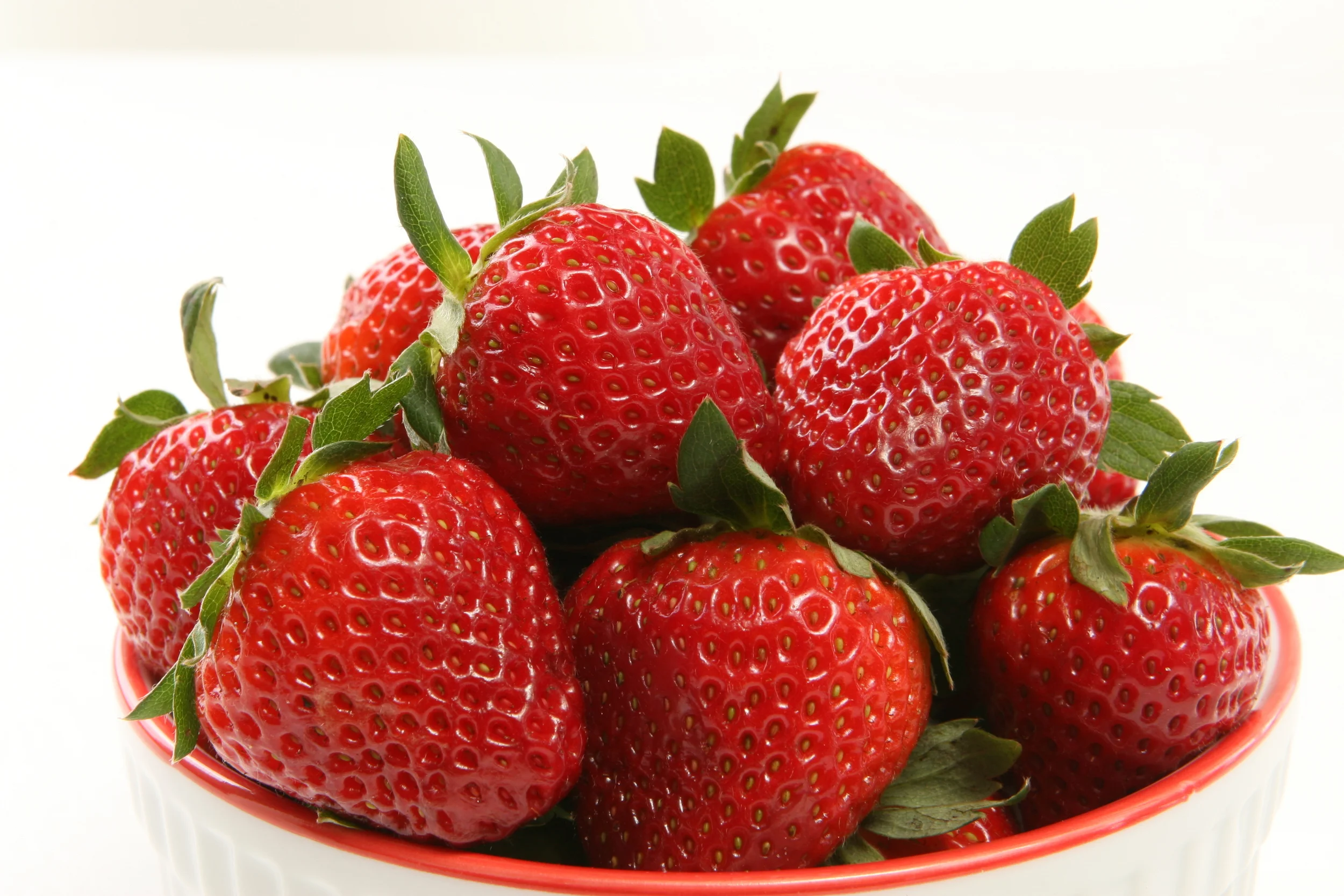
The internet is full of articles on whitening your teeth via strawberries and baking soda or other “natural” techniques. Unfortunately, modern scientific research does not confirm any of these treatments and actually provides good reasons to avoid them. Strawberries, while delicious and full of great nutrients, are highly pigmented, acidic and sugary. This combination makes them horrible candidates for brushing with/leaving on your teeth. While the color may lead to further staining, the sugar and acid can actually lead to tooth decay. However, fear not!

Hydrogen peroxide is a perfectly healthy and safe way to whiten your smile and will not cause damage to your teeth.


5. How do home whitening solutions differ from those provided at Thousand Oaks Family Dentistry.

The only difference between a whitening service you would receive at our office and one you would purchase at a store is concentration of peroxide. The higher the peroxide concentration, the quicker the results. However, more peroxide necessitates more precise methods of delivery. This is done to prevent excess material from coming into contact with your gums/tongue and bleaching or irritating them.  When performing in office Zoom! treatments, we take about 20 minutes to block out all of your gum tissue with a special material to avoid any extra bleaching. With this level of precision, we can use a 35% bleach. Trays can be provided with a concentration up to 20%, as they “lock in” the peroxide around the tooth. Whitening strips and other take home products can only be sold with about 10% peroxide, as they are not custom made and are almost guaranteed to touch the gum tissue.


6. How long does whitening last?

The great news about whitening is that once you achieve a tooth shade you are happy with, it will remain stable for quite some time. We recommend you follow the manufacturer’s instructions until you reach your desired shade. Beyond that, you can use the product once a month (usually, varies product to product) as a means of “touching up” your smile. You can keep the whitening product in your fridge for longer shelf life, and remove it an hour before application.


7. Will my teeth be sensitive?

Peroxide causes sensitivity as it has to open tubules within the teeth to enter the inner dentin. Once these tubules are open, they are more sensitive to movement, air and cold temperatures. It is hard to predict sensitivity in patients who have never whitened before. However, many over the counter pain medicines are great at minimizing whitening pain. If you have questions about whitening sensitivity and how to minimize it, feel free to call our office.


We hope this information will help you better choose a whitening system that is best for your unique circumstances. If you want any more information on home whitening or would like to know about the whitening services offered at our office, please give us a call. We are always happy and eager to inform our patients on the best products and services available!


Comment

Specialist Spotlight- Periodontist Dr. Jeremy Wilgus

Comment

Specialist Spotlight- Periodontist Dr. Jeremy Wilgus

http://www.thousandoaksfamilydentistry.com/blog/2014/6/9/specialist-spotlight-periodontist-dr-jeremy-wilgus#.U5aFCjm60yE=

At Thousand Oaks Family Dentistry, we are proud of the incredible patient centric experience we have built at our practice. At the end of every day, our goal is to see every person leave happier, healthier and more satisfied with their oral health.  However, this experience does not stop once you walk out our front door. A major component of our unique patient care is the incredible network of dedicated and skilled specialists we work with.

One of these great specialists is periodontist Dr. Jeremy Wilgus at Camarillo Periodontics. As a periodontist, Dr. Wilgus’ emphasis within dentistry is the treatment of periodontal disease, gingival recession and replacement of missing teeth with dental implants. Gingival grafting, crown lengthening, implant placement and bone grafts all fall under his scope of dental treatment.

At his office, Dr. Wilgus offers a combination of state-of-the-art technology and compassionate treatment. We are always impressed with the clinical results of his work, while our patients have nothing but great things to say about him and his office staff. Among the modern techniques he provides is the use of a Cone Beam CT scanner. This device allows him to capture a true 3D image of your jaw to aid in implant placement, diagnostics and other sensitive situations. This technology proves to be more accurate and revealing than the two dimensional nature of traditional dental X-rays.

Dr. Wilgus grew up in Sacramento, Ca and received his DDS from UCSF in 2003. He went on to finish a periodontal residency at the Los Angeles VA in 2006. In his off time, he enjoys spending time with his wife and two sons. You can typically find him cycling, golfing, skiing or coaching his son’s sports teams.

Whether you need a gingival graft, crown lengthening, or a complex bone graft you will be in good hands with Dr. Wilgus. Our office is extremely selective with our referral network and are proud to extend his services to our patients. If you are curious about periodontics or want to know more about our specialist referral network, feel free to call our office!

Additionally, make sure to check out Dr. Wilgus' office website at http://www.camarilloperio.com/ 

Comment

Zoom In Office Whitening

Comment

Zoom In Office Whitening

http://www.thousandoaksfamilydentistry.com/blog/2014/6/8/zoom-in-office-whitening#.U5U0HDm60yE

At Thousand Oaks Family Dentistry, we pride ourselves in staying at the forefront of dental technology. Every time a product is release, redesigned or improved, we take care to review its merits and how it can benefit our patients. Sometimes, products need further research and development before they are ready for our office. Others show great promise in improving results, comfort or efficiency.

    One of the most recent additions to our office is the latest Philips Zoom Whitening light and bleach system. While we have offered in-office whitening for many years, this update brings us to the forefront of bleaching speed and results. We are highly impressed with the research results and clinical data from this system and are proud to offer it to our patients.

    Almost every bleaching system works via some form of hydrogen peroxide, and Zoom whitening is no different. However, this system combines a specific concentration of peroxide with a highly specialized activation light. This light aids in the bleaching process by adding mild heat and energy to the peroxide oxidation reaction.

Our fantastic new Zoom light along with new bleach kits. 

Our fantastic new Zoom light along with new bleach kits. 

Essentially, bleaching works by allowing peroxide penetrate deep into the tooth dentin and degrade the compounds that cause staining. The Zoom lamp enhances this process by making the peroxide more viscous and speeding up the oxidation reaction rate. The end result is whiter teeth in a shorter amount of time, versus bleaching sans light.

Zoom appointments typically take about 75 minutes from checking in to leaving our office. We start by seating you and getting you set up with TV/Netflix/music. Once you are comfortable, we use a special blocking material to shield your gums from any stray bleach solution. This step is crucial, as the ultra concentrated bleach can easily discolor and irritate soft tissue. After we have your teeth isolated, we start the actual Zoom treatment. Your teeth are “painted” with the bleach formula and the light is focused at your mouth. The actual bleaching time is split into three 15 minute sessions. After your third session, we take out the gum shielding, rinse the bleach, and send you out with your brand new smile!

Many patients are concerned about the potential sensitivity associated with in office bleaching. This pain arises from microtubules within the teeth opening, which allows the peroxide to penetrate deep into the tooth. Unfortunately, these open tubules also allow sensitivity to air, cold temperature and even the bleach solution itself. Without prior whitening experience, it is difficult to predict how you will personally respond to Zoom bleaching. However, we have great methods and procedures for minimizing any discomfort you may feel.

In short, Zoom whitening provides beautiful and long lasting results in a single office visit. If you are interested in this service, or any of our other cosmetic procedures, please schedule an appointment with our office.

Additionally, feel free to take a look at the Zoom webpage FAQs for more information:

www.zoomwhitening.com/en_us/teeth_whitening_faq 


Comment

CAMBRA and Preventative Dentistry

Comment

CAMBRA and Preventative Dentistry

http://www.thousandoaksfamilydentistry.com/blog/2014/6/2/cambra-and-preventative-dentistry#.U4y0iDm60yE

    At Thousand Oaks Family Dentistry, we tend to ask a lot of questions. Some of them are are expected (“Do you floss regularly?”), while others (“What type of water do you drink?/Do you chew gum?”) might raise some confusion. While our investigations might seem slightly tedious, they are critical to our practice philosophy and how we treat our patients. These questions are part of a revolutionary preventative dentistry strategy known as CAMBRA.

    CAMBRA, or Caries (cavity) Management By Risk Assessment is a series of weighted factors and criteria that allow dentists to quickly and effectively determine tooth decay risk. By going over your dietary habits, home care techniques and medical history, we can obtain an accurate picture of how your tooth decay will progress (or continue to stay static) in the coming years. While this isn’t a “crystal ball” looking into your smile’s future, it is the best marker we have at determining your unique oral health situation.

    This screening technique relies on a simple thought process: if your habits and lifestyle lend themselves to an acidic, dry or bacteria prone mouth environment, then you will be at a greater risk for tooth decay. While this may seem obvious, what CAMBRA does is determine which factors are the most destructive, which ones can be “treated” and which ones are based on habits or lifestyle. Using this information, we can help our patients better manage their tooth decay, ultimately resulting in fewer office visits, fillings and incidences of dental discomfort.

Once we have determined your risk for tooth decay, we can make recommend products that can help you better manage your unique risks. One of these great products is Carifree Ctx3. This mouthwash-like rinse combines pH neutralization (to minimize mouth acidity), fluoride (to rebuild enamel) and xylitol (to naturally inhibit acid-producing bacteria). We love this rinse because it targets three of the decay cornerstones outlined in CAMBRA in an easy and convenient delivery method.

    Here is an example of how CAMBRA works: A 24 year old male comes in with and is diagnosed with a cavity on one of his molars. We go over his medical history and see he is taking medications that cause dry mouth. When discussing his eating habits, we find that he is a frequent snacker and enjoys sticky, processed foods. Finally, we note that he almost exclusively drinks bottled water and sports drinks. Using CAMBRA, we can determine that his tooth decay risk is likely caused by his medication and eating/drinking habits. We then recommend that he considers cutting back on snacking and sticking to 3 meals a day, stops drinking sports drinks (when not necessary) and starts drinking more filtered water, to both counteract the dryness caused by his medication and add fluoride exposure. While we will still need to treat his current tooth decay, we have now given him the knowledge and tools to better manage his oral care in the future.

    At our office, we treat every patient as a unique individual with unique needs. This is why CAMBRA fits so well with how we perform dentistry. It is not a one-size-fits-all approach, but rather a dynamic diagnosing tool that flexes with you. We are proud to operate our office on the CAMBRA model, and are incredibly satisfied with the results our patients have seen!

Comment

Emax Lithium Disilicate Crowns

Comment

Emax Lithium Disilicate Crowns

    When it comes to dental crown materials, there are many different options to suit a multitude of different scenarios. Some, like full porcelain crowns, provide excellent esthetic results. Others, such as full gold units, provide extreme durability along with desirable tooth-like physical properties. However, what options offer both beautiful cosmetic results along with enduring strength?

For many years, porcelain-fused-to-metal (or “PFM”) crowns were the cornerstone of “form meets function” in crown materials. These units are made by taking an alloy metal core and attaching a thin layer of porcelain over it, resulting in a durable tooth colored restoration. Unfortunately, this process is not without it’s downfalls. The porcelain has a tendency to crack and break between the opposing tooth and the hard metal sublayer. Additionally, the alloy substructure is extremely opaque, and prevents the overall crown from having the translucency of a natural tooth. This detracts from the overall esthetics of the final product.

While PFM crown still have a very useful place in dentistry (and are still regularly placed at our office for various reasons), modern technology has provided us with newer and more elegant solutions. Today, we can offer Emax as a means of creating a beautiful crown or bridge with long term durability.

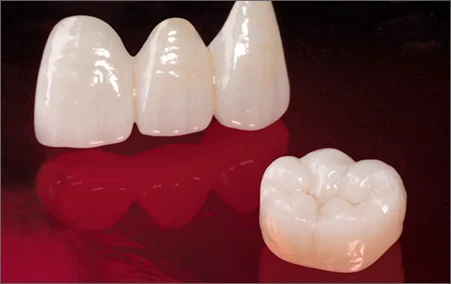
An example of a finished Emax dental bridge (right) and crown (left)

An example of a finished Emax dental bridge (right) and crown (left)

Emax is a lithium disilicate material that combines the translucency of porcelain with incredible strength. On average, these restorations can withstand 360-400 megapascals of force before breaking. What does this mean? Essentially, you could hammer a crown made of Emax into a plywood board and pull it out without damaging the structure. This incredible resilience means that Emax can be placed in almost any location in the mouth with extreme confidence.

In terms of esthetics, Emax rivals porcelain in that it provides an incredibly toothlike translucency. One of the most obvious “tells” of a dental crown is poor transmittance of light. Crown that do not respond to ambient light like natural teeth are just as visually jarring as poor tooth shade matching. Emax offers this low opacity in conjunction with the ability to have natural artifacts “baked” into the crown’s surface. Surface lines, color gradients and staining can be added to the crown to blend it perfectly with the adjoining teeth. Overall, this step helps detract from the “chiclet gum” look that is imparted to certain crown.

Of course, Emax in only one of the excellent crown options offered at our office. While it has some great properties, it can be a poor choice of restoration depending on a number of factors. Your crown material should take into account mouth location, neighboring teeth and your personal expectations. We regularly work with a number of different materials because our patients regularly need a number of different materials. If you have any questions Emax, or any other materials we offer at our office, please let us know at your next appointment!

Comment

After Hours Phone Service

Comment

After Hours Phone Service

http://www.thousandoaksfamilydentistry.com/blog/2014/5/27/after-hours-phone-service#.U4VWSTm60yE

At Thousand Oaks Family Dentistry, we pledge to be committed and available to our patients. We understand that your dental emergencies and concerns may not coincide with our business hours. In fact, they typically seem to arise at the least convenient times possible. This is why we are proud to offer our after hours phone service.

Our promise to our patients is anytime you call our office number, one of our staff member’s phones will ring- any time, day or night. You will never be forwarded to a call service and any message you leave will typically be followed up in about two hours (a little longer for late night calls).

After hours callers will typically encounter our office manager, Michael. He brings years of experience in dental emergencies, insurance billing and scheduling to the convenience of your phone. Whether you have a filling fall out at 10am on a Saturday or an insurance question on an idle Thursday evening, he will be there to answer.

Our office manager, Michael. hard at work taking phone calls. 

Our office manager, Michael. hard at work taking phone calls. 

Why do we provide this service? Simply put, our practice is a patient-centric environment. We know you have many options, and are honored that you choose to visit us at Thousand Oaks Family Dentistry. Dental care can be an intimidating endeavor, and thus we are here to make the process as easy, simple and convenient as possible.

Comment